
Ask ChatGPT for a merino base layer under $150, and seconds later, you've got four products with prices, photos, and links to buy. No page two.
That's what NZ shoppers are seeing right now. If your store isn't one of those four, you never got a look-in.
So working out how to get products recommended in ChatGPT is now part of the job for any NZ online store. Here's how ChatGPT picks products, how to get your catalogue in, and what to fix so ChatGPT product recommendations start going your way.
ChatGPT Is Now a Place People Shop
ChatGPT is a search engine now. Ask it for running shoes, and it returns product cards from real stores, with prices, images, and a link to buy. In NZ, there’s currently no checkout within the chat, so every click lands on the store’s own website.
ChatGPT ads have been running in NZ since April 2026, so paid traffic is already here.
The shoppers coming through this channel are worth chasing. Shopify's Q1 2026 platform data showed AI-referred orders up nearly 13x year-on-year. Those visitors converted around 50% better than organic search. It's not broken down by country, but the trend is clear.
This is gold for shop owners like you. It's why AI product discovery for ecommerce has moved from "interesting" to "on the list", and why your ChatGPT shopping visibility is worth checking now.
How ChatGPT Decides Which Products to Show
ChatGPT doesn't just read your website and pick at random.
Product Feeds Now Do Most of the Work
A product feed is a structured file that lists every product you sell, including its price, stock, and images. AI visibility platform Profound tracked approximately 1.75 million ChatGPT shopping prompts in July 2026 and found a sharp shift. On 10 July, the share of product picks pulled from feeds jumped from 8.26% to 61.54%. Profound kept tracking after that, and by 3 September 2026, feeds accounted for around 65% of the product picks it was monitoring.
OpenAI hasn’t confirmed the change, and it’s one company’s tracked prompts rather than real shoppers. But the direction is clear.
Fewer Stores Are Getting Named
In the same research, the number of different stores ChatGPT mentioned fell from 13,524 to 10,607, while the top 10 stores went from 22.5% of mentions to 41.8%. An AI answer can only list a handful of products, so the stores already named keep getting named. The research doesn't split results by country, but the same system decides which NZ stores get named.
You Can’t Buy the Organic Spots
OpenAI says its product results are picked independently and aren't ads. No one bids for organic placement, so your product data determines where you land.
The rest still comes from the open web: your product pages, reviews, and what other sites say about you. Content that adds something new carries more weight there, which is where information gain in SEO and AI comes in.
So if you’re wondering how to rank in ChatGPT answers, the short version is this. Get into the feed, then make your data better than everyone else’s in it.
How to Get Your Products Into ChatGPT, by Platform
In 2025, getting started meant filling in a short form. Things have changed, and your online store’s visibility in ChatGPT now starts with being in the catalogue it reads. Your route depends on the platform.
| Platform | How You Get In | What to Check |
| Shopify | Automatic, through the Shopify catalogue | No application needed. Check your titles, attributes, and stock levels |
| Etsy | Automatic | No application needed. Check your titles, attributes, and stock levels |
| WooCommerce, Shopware, or custom builds | Apply through OpenAI’s merchant page and submit a product feed | Feed plug-ins can format your products to OpenAI’s spec. Applications currently go on a waitlist, with a self-serve option planned |
| Stores using Stripe or Salesforce Commerce | Through your provider’s Agentic Commerce Protocol connection (the commerce standard OpenAI built with Stripe) | Ask your provider before joining a waitlist |
Check this first: OpenAI's Commerce Policies, updated in June 2026, exclude entire categories, including ingestible supplements, alcohol, and nicotine products. That covers plenty of Kiwi stores, from wineries to vape shops. If part of your range is restricted, leave those products out of the feed.
Make Your Product Data AI-Friendly
Once you’re in, this is where you win or lose. Good ChatGPT product listing optimisation comes down to giving the AI clear, complete facts it can match to what shoppers ask.
- Use Titles Shoppers Would Type: “Women’s merino crew base layer, black” beats “MRN-CN-W-BLK”.
- Say Who It’s for and What It Does: People ask ChatGPT for things like “a waterproof jacket for tramping in Fiordland”. Materials, sizing, and use cases help it match you.
- Fill in the Optional Fields: OpenAI says extras like reviews and rich media improve ranking, relevance, and trust.
- Group Your Variants: If every size and colour is listed as its own product, they compete with each other and split your reviews.
- Keep Price, Stock, and Shipping Current: Show NZD prices, real delivery timeframes, and refresh your stock list regularly because recommending an out-of-stock product costs you the AI’s trust.
- Make Your Site Easy to Read: Add product schema (code that labels price and stock) and don’t block OpenAI’s search crawler.
It's tempting to run 400 product descriptions through an AI writer, but that often produces samey copy with made-up details. It’s one of the most common AI tool mistakes we see. Strong product content for ChatGPT is accurate first and detailed second.
Quick Win: How Manuka South Showed Up in ChatGPT
Our client Manuka South took action in June 2025. By September, this was the AI search result for their product range. That was quick (and easy).
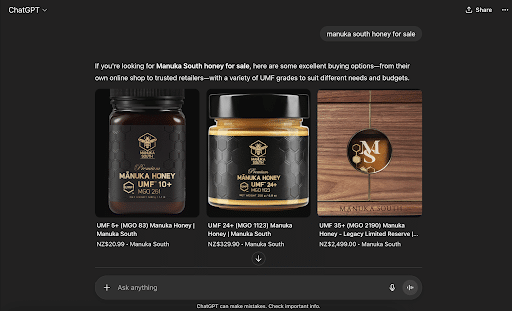
Try it for yourself. Open ChatGPT, search “Manuka South Honey for sale” and see what comes up.
The stores that sort their data now will be first in line.
How to Check If It’s Working
If you can’t measure it, you can’t improve it. Once a month, ask ChatGPT the questions your customers would ask and note which stores get named.
Then track ChatGPT referral traffic separately in GA4. Many ChatGPT links carry utm_source=chatgpt.com, so visits and sales are easy to spot. Three months of data beats one spot check.
Want ChatGPT to Recommend Your Products?
Getting in is step one. Getting picked is where the sales are. Our AI SEO team handles ChatGPT ecommerce marketing for NZ stores, from setting up your feed and fixing your product data to tracking how often ChatGPT names you.
Book a free consultation, and we’ll show you where you stand today and what it’ll take to get your products recommended by ChatGPT.