Most content strategies by NZ businesses are quietly failing right now. This isn’t because the writing is bad. It’s mostly caused by content that isn’t adding anything new.
When every sophisticated SEO practitioner applies the same logic to the same SERPs, the result is a collection of guides, how-tos, and comparison articles that all cover the same core topics in different words and word counts.
Google has a name for this problem. And a patent to fix it.
Information gain in SEO is how Google and AI search engines identify and reward content that actually contributes something the internet doesn’t already have. Our digital marketing agency in Auckland covers what you need to know.
Key Takeaways
- Information gain is a way of evaluating content based on how much genuinely new information it adds. Not just well-optimised.
- Google’s patent defines an information gain score as a measure of “additional information included in a document beyond information contained in documents previously viewed by the user.”
- AI search engines don’t like citing their own words. If your content repeats what’s already out there, it won’t get referenced.
- High information gain scores come from original data, contrarian perspectives, first-person experience, and visual evidence.
- The traditional Skyscraper playbook of ‘just make it longer and more comprehensive’ is far less effective; differentiation and originality now matter more than sheer length.
Skyscraper Is Out, Information Gain Is In

Still Doing a Better Version of the Same Thing? You Might be Losing Traffic
For years, the Skyscraper approach dominated SEO. In a capsule, it looked like this:
- Find what ranks.
- Write something longer, more detailed, more comprehensive.
- Outrank everyone.
The problem? ChatGPT, Claude, Gemini, and several more LLMs have read the internet.
They can synthesise comprehensive coverage from ten articles in seconds. Comprehensive is no longer a competitive differentiator. It’s the baseline any LLM can replicate on demand.
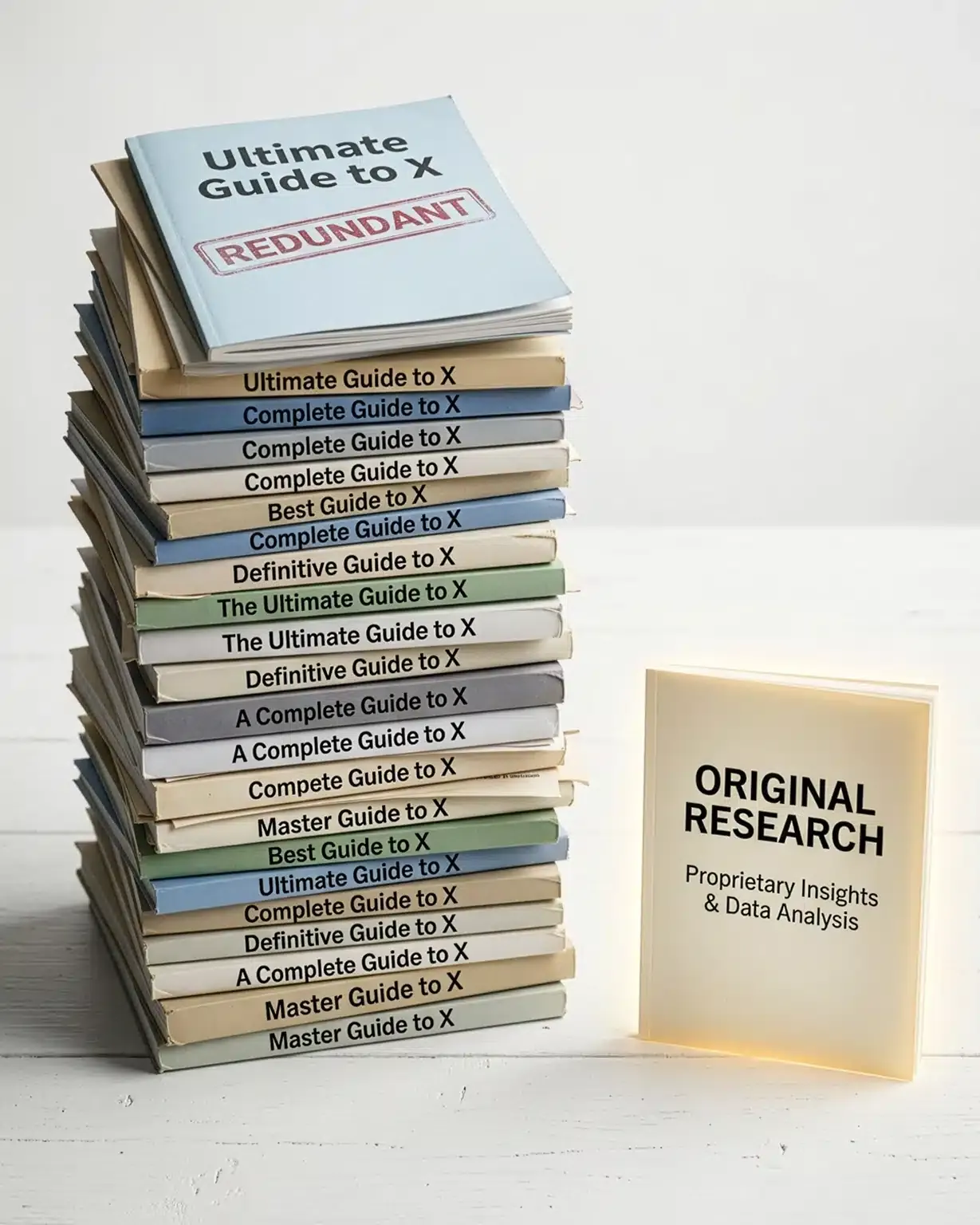
Publishing yet another “Ultimate Guide to X” can still help you get cited by AI as long as it’s packed with new, helpful information. The honest question every piece of content now demands: Does this need to exist?
How LLMs Identify and Filter Redundant Content
AI systems don’t just read your content. They compare it. Google can treat documents that add no new information as redundant and may rank them lower relative to more informative results.
This is the core mechanic of information gain scores in practice.
It’s not about plagiarism or word-for-word copying. It’s about entity-level sameness. You can rewrite a competitor’s article from scratch and still score low if you’re covering the same:
- Topics
- Angles
- Conclusions
Imagine watching a show in 2026 that’s practically a remake of Outrageous Fortune. It might be entertaining for a while, but if there are no original jokes or storyline, it won’t go past the first season.
This is why generic how-tos and ultimate guides are getting wiped out.
A study by analytics firm Authoritas found that a site previously ranked first in a search result could lose up to 79% of its traffic for that query when an AI Overview appears above it.
And if your content is the same as what the AI is already synthesising? It won’t bother citing you.
Defining the Information Gain Score
The most significant applicable patent is Google’s Contextual Estimation of Link Information Gain (Patent ID: US20200349181A1), first filed in October 2018 and published in November 2020.
In plain language, it works like this:
- A user searches for a topic. Google shows them a first set of results.
- If they keep searching, Google identifies a second set of candidate documents.
- Those new documents are re-ranked based on their information gain score: how much additional, unique information they contain relative to what the user has already seen.
- A higher information gain score gets promoted. Lower gets demoted.
Google’s Helpful Content systems, introduced after this patent was filed, move in the same direction: they’re designed to prioritise original, people-first content and reduce the visibility of repetitive, low‑value pages.
Why AI Won’t Cite Content It Helped Create
Understanding the Training Data Loop
Here’s the uncomfortable truth about AI-generated content.
LLMs are trained on existing web content. When you use AI to write a blog by summarising what already ranks, you’re producing a reshuffled version of content the AI already knows. AI can serve up consensus content to answer a searcher’s query.
However, it can’t generate original, factual:
- Interviews
- Survey data
- Product reviews
- New perspectives based on real experience.
That first-party data is what builds information gain. If you run a trade business in NZ, you probably have unique experiences and tips for potential customers in your niche. This is your ultimate weapon in 2026.
AI search systems are designed to highlight sources that add unique, high-value information and are less likely to reference derivative, me‑too content. It looks for sources that add something it hasn’t already synthesised. They love new information, and rightfully so!
How Novelty Became Measurable
An information gain score reflects how much additional information a page offers beyond what a user has already seen, rather than how different it is from every document on the web.
The patent shows how Google could use machine learning to estimate this ‘newness’ and feed those scores into ranking systems, so that follow‑up results surface pages that add fresh details instead of repeating the same entities and ideas in new words.
In practice, this gives Google a way to spot redundant content at scale—not just copy‑paste duplication, but pages that cover the same topics, conclusions, and entities without adding anything meaningfully new.
Why Generic How-to Guides Are Losing Organic Reach
Studies even show that up to 80% of new companies might have fewer clicks because AI can produce summaries of the latest scoop. It’s really convenient for the readers, especially since short-form content is on the rise due to our shorter attention span. Recent research shows average on-screen attention spans around 47 seconds, with a median near 40 seconds.
The content hit hardest? Step-by-step guides, listicles, and “what is” explainers. Exactly what AI can already summarise without you.
If your content strategy is built around how-to guides that cover ground every competitor covers, you’re not just losing rankings. You’re losing relevance.
4 Pillars of High-Value Information Gain

1. Proprietary Data: Turn Internal Stats Into Industry Benchmarks
Your business sits on data nobody else has. Customer results. Campaign performance. Conversion rates. Industry patterns you’ve spotted across dozens of clients.
After a year-long analysis of 250 B2B websites, Stratabeat found that companies conducting original research tended to increase Google Top 10 organic ranking keywords.
Publishing your own data gives AI something to cite that it genuinely can’t find anywhere else.
Take our A2W case study, for example. This Wellington-based hot water heat pump installer came to our team with a content and SEO challenge: they were selling new technology most Kiwis had never heard of. Nobody was searching for it yet.
We built out their website content with separate, optimised pages for each product and a customer journey designed to educate first, convert second.
The result? A2W now converts 30-40% of every quote form submission they receive. That kind of publicly shared outcome data is exactly the kind of original information that builds authority and earns AI citations. No competitor can replicate it because no competitor has those numbers.
2. The Contrarian View: Challenge “Best Practice” with Real Results
As much as you can, take strong P.O.V.s and stances that are risky and controversial, but 100% true.
Disagree with a common industry assumption? Prove it with data and publish it. That’s information gain in action.
Imagine a car dealer that publishes an article that says, “Sedans are the best vehicles for tradies.” Sounds insane, right? But if they can back it up with facts, numbers, and multiple real-life examples, this would rank well. (We doubt you can find any data to back this up. We love our utes too much.)
3. First-Person Narrative: Using “I” and “We” to Satisfy E-E-A-T
Google’s own guidelines are direct about this. Google’s helpful content documentation explicitly asks whether content demonstrates first-hand expertise and a depth of knowledge that only comes from real experience.
Using “I” and “we” isn’t informal. It’s a trust signal. It basically says, “Hey, this is my experience and is unique to me.” Remember, AI can’t write something that you lived through.
4. Visual Evidence: Original Diagrams AI Can’t Hallucinate
Original charts, process diagrams, and infographics built from your own data are citation gold. AI can describe a concept. It can’t reproduce a graph you built from your own client results.
Visuals also serve a practical SEO function. They’re indexed separately, they earn backlinks, and they give users a reason to click through even when an AI summary has answered their basic question.
How to Optimise Content for Human Value
Step 1: Perform Content Gap Analysis: What Are The Top 10 Missing?
Read the top 10 results for your target keyword. Note every entity, angle, and sub-topic they cover. Then ask: What question would a reader still have after reading all of these?
That gap is your brief.
Step 2: Inject the “Expert Layer”
Once you know the gap, fill it with something only your business can provide:
- A client result that proves or disproves a common assumption
- A process your team uses that competitors don’t mention
- An opinion from someone with genuine industry experience
- A data point from your own analytics or client work
This is the expert layer. It’s what separates content that ranks from content that gets cited.
Step 3: Verify Citations and Originality Proofs
Before publishing, check every claim:
- Is this stat from the original source, or a third-party summary of it?
- Is this perspective genuinely yours, or reworded from a top-ranking article?
- Would a reader who has already read the top 5 results learn something new here?
If the answer to that last question is no, you haven’t cleared the information gain bar.
Making Your Brand Un-Ignorable to AI Agents
The content arms race has changed. More words, more headers, more “comprehensive coverage.” None of that is a differentiator anymore. The brands that get cited by AI in 2026 are the ones bringing something to the table that the internet genuinely doesn’t already have.
Is your content just adding to the noise? Contact numero® today and start building a strategy that AI search engines actually want to cite.