Zero-click search now describes the majority of Google searches. According to Semrush, over 58% of Google searches now end without a single click to any website.
What does this mean? Apparently, most people get their answer straight from the search results page and never visit yours. This might even sound like how you look for answers online.
That’s the bad news framing. Here’s the better way to look at it:
The businesses panicking about zero-click search are asking the wrong question. The right question is: are you the brand being cited when nobody clicks?
Key Takeaways
- Zero-click search occurs when Google or an AI search engine like ChatGPT or Perplexity answers a query directly, without requiring a website visit.
- Research shows that on Google, when an AI summary appears, users click traditional results just 8% of the time, versus 15% without one.
- Traffic is down. But revenue doesn’t have to be. AI search visitors convert 23x better than traditional organic traffic, Ahrefs’ study shows.
- In 2026, success is measured by Brand Presence and Citation Share, not just sessions and clicks.
- Structuring your content for generative AI extraction is the most important thing you can do right now.
60% of Users Are No Longer Clicking Search Results. Why?
There’s a shift from “Search Results” to “Answer Engines”
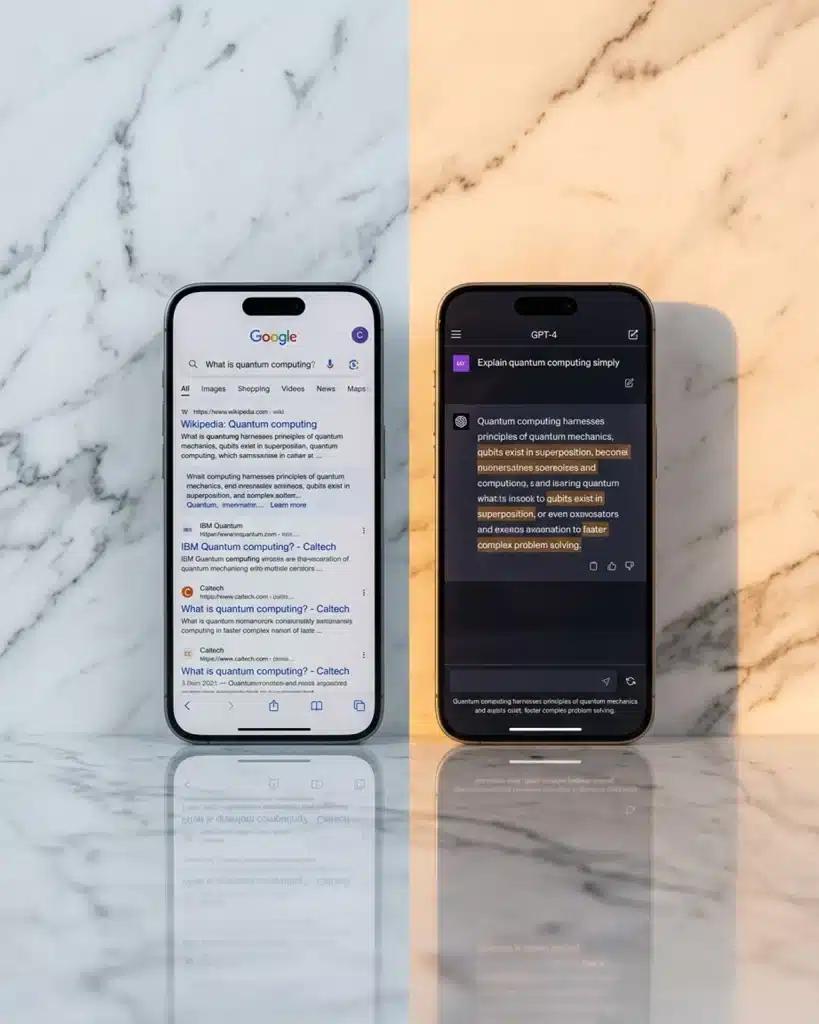
Google isn’t really a search engine anymore. It’s an answer engine. Featured snippets were the beginning. Knowledge panels came next. And yep, you guessed it, AI Overviews are just the most aggressive version of that direction.
Searches that trigger an AI Overview now show an average zero-click rate of 83%. Traditional queries without AI Overviews sit at around 60%, according to Similarweb. And it’s not just Google. Bain research found that 40–70% of AI search platform users use tools like ChatGPT to research and summarise information, check the news, and get shopping recommendations. People are having conversations with AI instead of scanning links.
How is this hitting NZ businesses?
This isn’t just a US phenomenon. Independent research found that 48% of New Zealanders under 45 already use AI tools when researching a business, product, or service. And here’s the kicker: 1/3 of that group changed their opinion of a business based on what the AI told them.
If you’re not managing what AI says about your brand, someone else’s content is making that decision for you.
Why a traffic drop isn’t always a revenue drop
Here’s where most business owners get spooked unnecessarily.
Lower traffic does not necessarily translate into lower revenue. AI search visitors convert 23x better than traditional organic traffic, with AI search platforms generating 12.1% of signups despite accounting for just 0.5% of overall traffic.
The person who reads an AI summary of your service decides they want more and then searches your brand directly? That’s a warmer lead than someone who stumbled across a blog post.
The problem isn’t zero-click search. The problem is not being the brand that the AI cites.
Brand Impressions: The 2026 Version of Page Views
Re-defining what “visibility” means now
You might rank position one and see minimal traffic.
Traditional click-through rate metrics don’t tell the whole story anymore.
Meanwhile, your brand could be appearing in AI Overviews and ChatGPT responses for dozens of high-intent queries, none of which appear in your Google Analytics.The top of the funnel is happening inside the AI, not on your website. If you’re not measuring it, you’re flying blind.
Why being cited by AI builds trust fast
There’s a real authority signal that comes with being the source that AI references. 75% of Gen Z and millennials are more likely than boomers to completely trust AI-generated answers more when brands are mentioned in responses.
Being the cited source in an AI answer is the 2026 version of being quoted in a Herald article. This is third-party credibility at scale.
The conversion pattern most analytics miss
A customer asks ChatGPT, “What’s the best digital marketing agency in Auckland?” Your brand gets mentioned. They don’t click. Two weeks later, they look up your name and call you.
Your reporting logs it as “direct.” Your SEO report sees nothing. But the AI citation was the first touchpoint, and you’d never know without asking.
How To Structure Content To Get Cited By AI
GEO (Generative Engine Optimisation) is about structuring your content so generative AI systems can extract, verify, and cite it. The goal shifts from “rank for this keyword” to “become the source AI search engines quote when answering this question.”
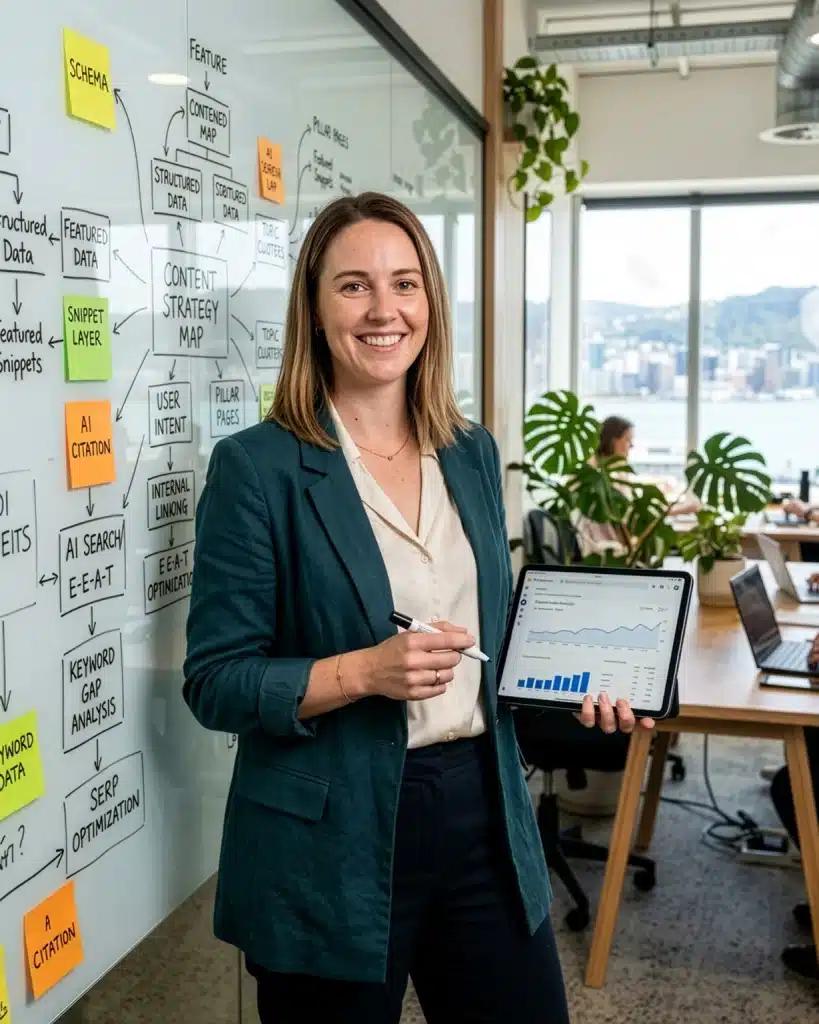
Write for the “Snippet Layer” first
44.2% of all LLM citations come from the first 30% of a piece of content. Your opening paragraphs carry more citation weight than anything buried lower on the page.
Lead with the answer. Then explain it. Every section should open with a direct, clean response to the question in the heading.
Own the “What Is” definitions in your niche
Every industry has definition queries. Let’s take digital marketing, for example:
- “What is GEO?”
- “What is a zero-click search?”
- “What is schema markup?”
Write definitions in a simple format: [Term] is [clear, standalone definition]. Put it directly under your heading. That’s what AI extracts for knowledge panels and AI Overviews.
Use structured formats that AI can easily parse
- Comparison tables for evaluating options
- Numbered lists when order matters
- Bullets for features, benefits, or criteria
- 40–60 word answer blocks at the top of each section
Reference Google’s Structured Data Documentation to understand how your content gets read by AI crawlers.
Don’t skip schema markup
The structured data formats that carry the most weight include Organisation schema, Product schema, FAQ schema, and Author markup.
For NZ service businesses, mark up your name, address, phone number, service areas, and reviews. If an AI can’t verify your details from your own structured data, it’s less likely to cite you, or it may cite something inaccurate instead.
How to Monetise AI Citations
Map your content to buying intent
Not all AI citations are equal. A mention in “What is content marketing?” has a different commercial value than a mention in “Best SEO agency in Auckland.”
| Query Type | Example | Value |
| Informational | “What is GEO?” | Brand awareness, top of funnel |
| Comparison | “Best SEO agency NZ” | High commercial intent |
| Transactional | “Hire an SEO agency” | Still drives clicks, optimise hard |
AI Overviews are expanding beyond purely informational queries; commercial and transactional AI Overviews are on the rise.
That means buying queries are increasingly being answered by AI search engines. You want to be the brand cited in those answers.
Leave a reason to click
Don’t try to answer everything in your content. Answer enough to get cited, then include something generative AI can’t replicate:
- Original tools or calculators.
- Case studies with real results.
- Proprietary NZ data or research.
- Interactive resources users need to visit your site to use.
Build your citation footprint off-site
Close to 90% of citations in AI answers come from third-party online resources, such as media coverage, industry commentary, and social platforms.
For NZ businesses, that means earning coverage in Stuff, NZ Herald, Scoop, and relevant industry publications. A mention in a credible NZ media outlet seeds your brand as a citation target for AI search engines.
Want To Know Where Your Brand Stands In AI Search Right Now?
We can audit your content structure, schema markup, and citation footprint, and build a strategy that puts you in the answer, not just on the page. Book a free consultation or call us on 09 390 3997.
How To Properly Track Performance When CTR Falls Short
Old metrics tell half the story now. You need two layers of measurement:
Traditional tools (still essential):
- Google Search Console: impressions, rankings, AI Overview triggers
- Semrush/Ahrefs: AI Overview tracking, CTR impact by keyword
New metrics to track:
- Branded search volume: going up without a paid campaign? That’s AI-driven awareness converting to intent
- Assisted conversions: ask your potential clients, “How did you hear about us?” and follow up with “Did you use any AI tools when researching?”
- Direct traffic spikes: often unattributed AI referrals across Google and AI search engines like ChatGPT and Perplexity
Traffic decline doesn’t always mean revenue decline. You may be building brand awareness that converts through other channels. Build CRM workflows that capture this; even a simple intake question about how someone first encountered your brand makes a difference.
Adapting to the Invisible Search Journey
Zero-click search isn’t taking something from you. Rather, it’s changing where value gets created. The brands that win in 2026 are building content, authority, and structured data that make generative AI systems trust them as the go-to source in their niche.
Don’t fear the zero-click era; dominate it. Let numero® help you build your 2026 SEO strategy and secure your spot as the top-cited authority in your industry.